
Introduction
Western Uttar Pradesh, encompassing Rohilkhand and Braj, is one of the most vibrant and strategically important regions of the state. Bordered by Uttarakhand, Haryana, Delhi, Rajasthan, Madhya Pradesh, and sharing a short frontier with Nepal, it enjoys immense geographical and economic significance. Unlike eastern Uttar Pradesh, its cultural and linguistic identity is closer to Haryana and Rajasthan, giving it a distinct character. With rapid urbanization, industrial expansion, and agricultural prosperity, Western Uttar Pradesh has emerged as A Vital Engine of Development in North India.
Geography of Western Uttar Pradesh
The northwestern location of this region provides unique geographical features. The soil here is predominantly loam, lighter than the clay-rich soils of eastern Uttar Pradesh, with sandy patches and loess deposits influenced by the Thar Desert. These variations make the land suitable for diverse crops such as sugarcane, wheat, and pulses. Fertile plains, combined with proximity to Delhi and neighboring states, have turned the region into a hub for agriculture, trade, and connectivity. Its brief international border with Nepal in Pilibhit further enhances its geopolitical importance.
Demography
According to the 2011 Census, Western Uttar Pradesh has a population exceeding 71 million. The region is home to diverse communities including Ahirs, Brahmins, Dalits, Gujjars, Jats, Rajputs, Rohilla Pashtuns, Chamars, and Tyagis. This demographic richness shapes the cultural fabric, influencing festivals, traditions, and social structures. The coexistence of multiple communities has given the region a vibrant and inclusive identity, where diversity strengthens social and cultural life.
Major Cities of Western Uttar Pradesh
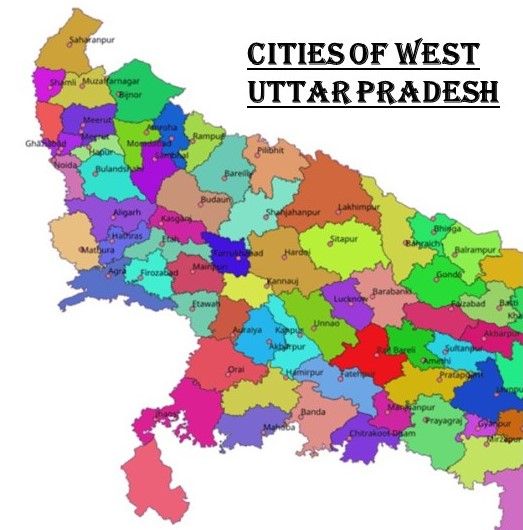
Western Uttar Pradesh comprises 26 districts grouped into six divisions: Saharanpur, Meerut, Moradabad, Agra, Aligarh, and Bareilly. Each district has a prominent city serving as its administrative and cultural hub:
- Noida: A planned modern city, famous for IT hubs, multinational companies, and educational institutions.
- Ghaziabad: Known as the “Gateway to Uttar Pradesh,” it is a major industrial city with strong connectivity.
- Meerut: Renowned for its role in the 1857 uprising, now a hub for sports goods and education.
- Agra: Globally celebrated for the Taj Mahal, blending Mughal heritage with industries like leather and handicrafts.
- Mathura: Revered as the birthplace of Lord Krishna, a spiritual and cultural destination.
- Bulandshahr: Famous for pottery and agriculture, combining history with modern development.
- Aligarh: Home to Aligarh Muslim University and the lock industry, earning the title “City of Locks.”
- Moradabad: Popularly called the “Brass City of India,” exporting metal handicrafts worldwide.
- Muzaffarnagar: Nicknamed the “Sugar Bowl of India,” thriving on sugarcane cultivation.
- Saharanpur: Renowned for its wood carving industry and fertile lands.
Other important cities include Bareilly, Budaun, Rampur, Shahjahanpur, Etah, Firozabad, Mainpuri, Shamli, Bijnor, Farrukhabad, Etawah, and Auraiya. Together, these urban centers drive the region’s economy, culture, and connectivity.
Languages Spoken
Western Uttar Pradesh is linguistically diverse, with two major dialect zones:
- Khadiboli: Spoken in northern districts like Meerut, Muzaffarnagar, Ghaziabad, and Saharanpur. It is considered a precursor to standard Hindi.
- Braj: Dominant in southern districts such as Mathura, Agra, Aligarh, and Etah, with immense cultural significance in literature and devotional traditions.
Hindi and Urdu are widely spoken across the region, shaped by historical interactions with Persian and Delhi’s linguistic evolution.
Conclusion
Western Uttar Pradesh stands out as a region where history, culture, and modern development converge. From the spiritual aura of Mathura to the industrial vibrancy of Noida and Ghaziabad, its cities reflect the diversity and dynamism of North India. With its strategic location, fertile lands, and cultural richness, Western Uttar Pradesh continues to play A Vital Role in Shaping the Identity and progress of the state.