
Introduction
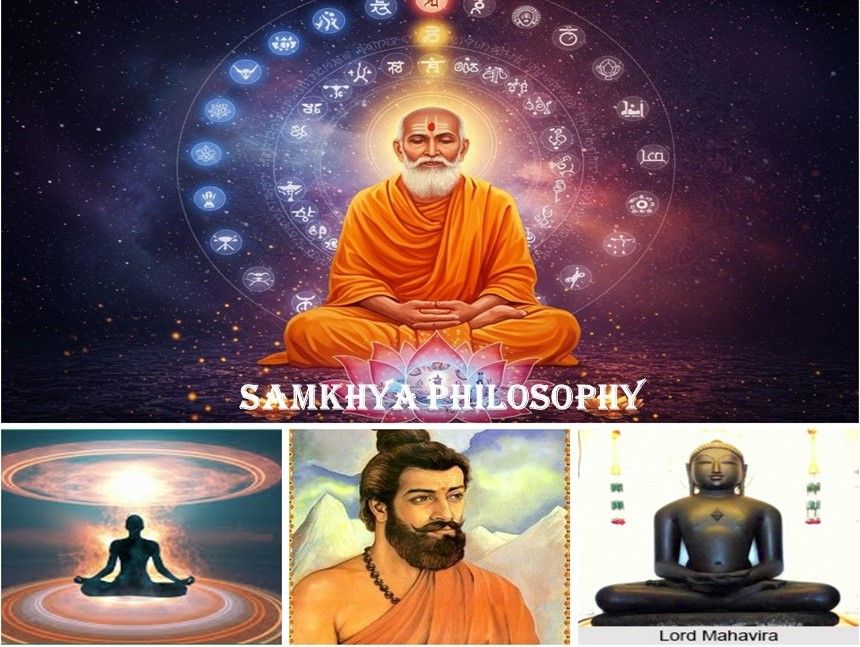
Samkhya Philosophy, one of the six orthodox schools of Indian philosophy, is among the earliest systematic attempts to explain existence through rational analysis and enumeration. Traditionally attributed to Sage Kapila, Samkhya emphasizes dualism between Purusha(consciousness) and Prakriti(nature), and its ideas have profoundly shaped Indian spiritual and philosophical traditions. Its influence extends across Vedic and non-Vedic texts, including the Upanishads, Bhagavad Gita, Mahabharata, as well as Buddhist and Jain philosophies.
Influence on Buddhism and Jainism
Samkhya Interaction with Buddhism and Jainism is evident in their shared concern with suffering and liberation. Jainism underwent major reorganization in the 9th century BCE, while Buddhism emerged in the 5th century BCE. These traditions likely exchanged ideas with early Samkhya thought.
- Buddhism: Both Samkhya and Buddhism emphasize suffering (dukkha) as central to human existence. Later Samkhya texts highlight suffering as a key philosophical concern, possibly influenced by Buddhist thought. The Buddhacharita (2nd century CE) indicates that Samkhya had already developed reliable reasoning methods by the 5th century BCE, showing its analytical approach was firmly established early on.
- Jainism: The Jain doctrine of multiple souls (jiva) parallels Samkhya’s concept of numerous purushas. While Samkhya did not depend solely on Jain ideas, it was shaped by a broader range of ancient theories about the soul found in both Vedic and non-Vedic traditions.
Influence on the Upanishads
Samkhya’s philosophical framework resonates strongly with the Upanishads.
- The Katha Upanishad (5th–1st century BCE) presents an early conception of Purusha, aligning cosmic spirit with the individual soul (Atman).
- The Shvetashvatara Upanishad references Samkhya alongside Yoga, exploring metaphysical themes.
- Concepts like ahamkara (ego) appear in the Chandogya and Brhadaranyaka Upanishads, while the enumeration of tattvas is reflected in the Taittiriya, Brihadaranyaka, and Aitareya Upanishads.
- Upanishadic sages such as Yajnavalkya and Uddalaka Aruni developed the idea of pure consciousness, which later became central to Samkhya.
Influence on the Bhagavad Gita and Mahabharata
Samkhya’s principles are woven into the fabric of epic literature.
- In the Bhagavad Gita, Samkhya is associated with true knowledge and understanding. While the text discusses the three gunas (sattva, rajas, tamas), it does not use them in the technical sense of classical Samkhya. Instead, the Gita integrates Samkhya ideas into a broader synthesis that includes devotion (bhakti) and Vedantic concepts of Brahman.
- The Mahabharata, particularly the Mokshadharma section of the Shanti Parva (400 BCE–400 CE), elaborates Samkhya concepts alongside other philosophical viewpoints. It honors thinkers like Kapila, Asuri, and Pancasikha, who were instrumental in shaping early Samkhya.
By the time Samkhya was systematized in the early first millennium CE, the question of a deity had become largely irrelevant to its framework. Closely linked to Yoga, Samkhya provided the theoretical foundation upon which Patanjali’s Yoga Sutras were built.
Other Influences of Samkhya Philosophy
Samkhya’s dualistic ideas also appear in Vedic hymns:
- The Rig Veda’s Indra-Vritra myth reflects dualism.
- The Purusha Sukta and Nasadiya Sukta emphasize cosmic duality, resonating with Samkhya’s principles.
- The Atharvaveda also references Purusha, highlighting the continuity of these ideas across early texts.
Conclusion
Samkhya Philosophy has left a lasting imprint on Indian thought, influencing Buddhism, Jainism, the Upanishads, The Bhagavad Gita, and the Mahabharata. Its rational framework of dualism, enumeration of tattvas, and focus on suffering and liberation shaped not only Hindu traditions but also Buddhist and Jain philosophies. Even in Vedic hymns, traces of Samkhya’s ideas can be found, underscoring its foundational role in the evolution of Indian spirituality and philosophy.