
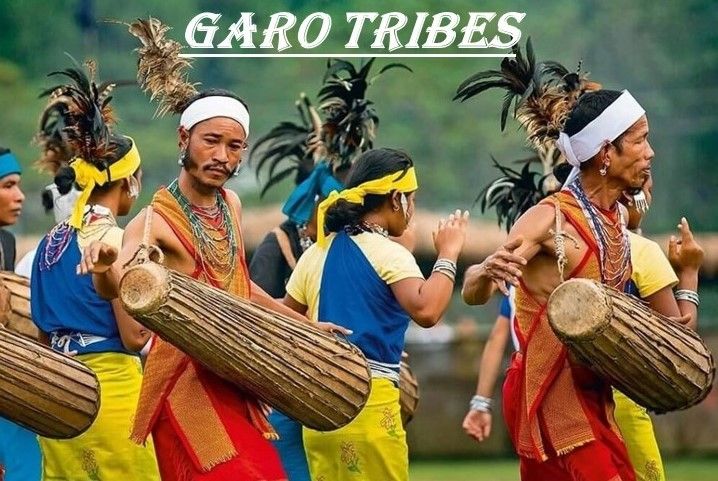
The Garo tribes, who proudly identify themselves as A’chik or Mande, are among the most prominent indigenous communities of Northeast India. Known for their cheerful, peace-loving, and hospitable nature, the Garos have nurtured A Rich Cultural Heritage that continues to flourish. Their lifestyle is deeply connected to food, music, and dance, making them one of the most expressive and vibrant groups in the region.
Origins and Settlement
The Garos trace their ancestry to a common ancestress, though scholars suggest they migrated from Tibet nearly 400 years ago. They eventually settled in the fertile Brahmaputra Valley and the hilly terrains of Meghalaya. Today, the majority of the Garo population resides in Meghalaya, while smaller communities are spread across Nagaland, Assam (Karbi Anglong, Goalpara, Kamrup), and parts of West Bengal such as Cooch Behar, Jalpaiguri, Bardhaman, and Dinajpur.
Language and Oral Traditions
The Garo language, also known as Garrow or Mande, belongs to the Bodo branch of the Sino-Tibetan family. Historically, the language lacked a written script, and oral traditions became the primary means of preserving folklore, customs, and beliefs. Sub-groups of the language include Chibok, Megam, Matabeng, Ruga, Achik, Ganching, Abeng, Atong, Dual, Matchi, and Gara. Interestingly, Garo shares similarities with other regional languages such as Rava, Kok-Borok, Boro-Kachari, and Dimasa, highlighting its cultural connections across Northeast India.
Social Structure
The Garo society is distinctive for its matrilineal and matrilocal system, where inheritance and lineage are traced through the mother. Women enjoy a higher social status, and property ownership is often communal. The tribe is divided into several linguistic and cultural groups, including Aure, Chisak, Matchi-Dual, Metabeng, Ateng, and Ruga. While monogamy is the norm, polygamy is permitted, and widow remarriage is socially accepted.
A unique institution within Garo society is the Nokpanthes, or youth dormitories, which serve as centers for cultural learning and social bonding. However, village administration traditionally excluded women, creating a balance between matrilineal inheritance and patriarchal governance.
Occupation and Economy
Agriculture forms the backbone of Garo livelihood. The tribe practices Jhum cultivation, a traditional shifting farming method suited to the hilly terrain. Crops such as paddy, cotton, maize, millet, and pulsesare commonly grown. Farming not only sustains their economy but also plays a central role in community life, festivals, and rituals.
Religion and Beliefs
Religious practices among the Garos are diverse. A significant portion of the population has embraced Christianity, particularly Baptism and Roman Catholicism, while others follow denominations such as Seventh-day Adventism and Anglicanism. Despite these influences, many Garos continue to observe their traditional Animist-Hindu customs, blending ancient rituals with newer faiths in a unique cultural synthesis.
Music, Dance, and Festivities
The Garos are Passionate about Music and Dance, which are integral to their celebrations. Their dances are broadly categorized into Santalo Chroka and Abani Kamrangko Mesokanirang, with other forms such as Mi Sua, Koch, Napsepgrika, Kambe Toa, Rabha, Gaewang Roa, and Chambil Moaadding to the diversity. Musical instruments used include chordophones, aerophones, idiophones, and membranophones, showcasing their indigenous craftsmanship and love for rhythm.
Conclusion
The Garo tribes represent a fascinating Blend of tradition and adaptability. Their matrilineal society, agricultural practices, and vibrant cultural expressions make them a unique community within India’s diverse tribal landscape. Despite modern influences, the Garos continue to preserve their identity, ensuring that their heritage remains alive for generations to come.