
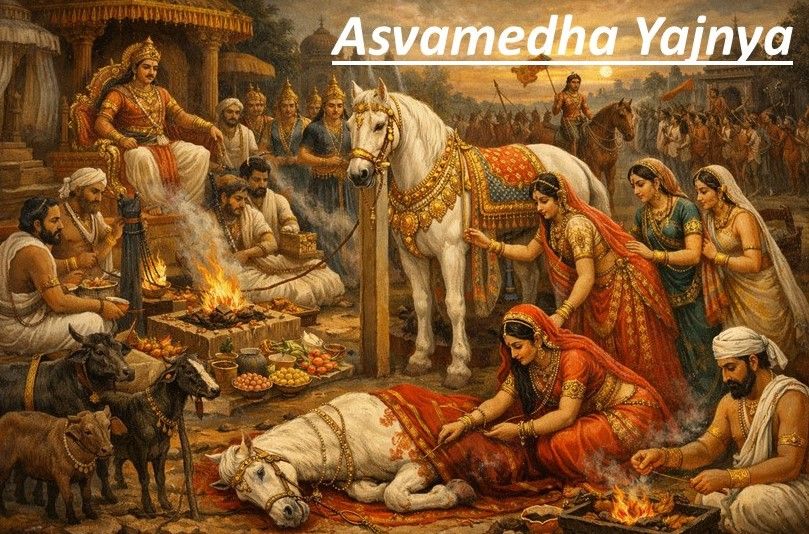
The Asvamedha Yajnya, often referred to as the horse sacrifice, was one of the most striking and politically charged rituals of the Vedic age. Rooted in the Yajurvedaand elaborated in the Satapatha Brahmana, it was far more than a religious ceremony. This grand spectacle symbolized a king’s supremacy over neighboring rulers, blending spirituality with political ambition and diplomacy.
Ritual Process
- Selection of the horse: In early spring, a stallion aged between 24 and 100 years was chosen. Priests consecrated it with water while whispering sacred mantras into its ear.
- Year-long wandering: Released towards the northeast, the horse roamed freely for a year, guarded by 400 warriors and 100 horses. Its wandering symbolized the sun’s annual course. If it entered another kingdom, rulers had to Submit or Face Battle. Victorious kings demanded tribute, reinforcing their overlordship.
- Ceremonies at home: While the horse wandered, continuous rituals were performed at the sacrificer’s palace. If the horse returned safely, additional ceremonies marked its arrival.
Final Sacrifice
The concluding rites were elaborate and deeply symbolic:
- Royal adornment: The horse was bathed, anointed with ghee, and adorned with gold ornaments by the chief queen and royal consorts.
- Animal offerings: Alongside the horse, a hornless goat, wild ox, and seventeen other animals were tied to sacrificial stakes.
- Symbolic union: The chief queen spent a night beside the horse, signifying fertility and cosmic union.
- Dissection and offering: The horse’s body was dissected with golden, silver, and copper needles, its flesh roasted, and portions offered to deities with cries of svaha.
- Distribution of spoils: Priests were rewarded with treasures collected during the horse’s wanderings.
Historical Mentions
- In The Mahabharata, Yudhisthir performed the sacrifice after the Kurukshetra war, with Arjuna guarding the horse and Draupadi participating in the final rites.
- The Ramayana describes King Dasarath’s performance, with Queen Kaushalya piercing the horse’s flesh.
- Historical records note that Samudragupta revived the practice in the 4th century CE, while the last known performance was by Jai Singh II of Amber in 1716.
Decline and Criticism
The ritual faced criticism from reformers and spiritual leaders. Gautam Buddha condemned it, emphasizing compassion over animal sacrifice. Over time, the yajnya lost its religious significance and became more of a political statement. By the medieval period, it had largely faded, though occasional revivals occurred.
Political Significance
The Asvamedha was less about centralized empire-building and more about establishing a federation of kingdoms under one overlord. Each kingdom retained autonomy in internal affairs but acknowledged the supremacy of the sacrificer. Thus, the ritual reinforced royal authority while maintaining a loose confederation of states.
Conclusion
The Asvamedha Yajnya remains one of the most fascinating examples of how religion, politics, and symbolism intertwined in ancient India. It was not merely a ritual of sacrifice but a grand spectacle of power, diplomacy, and spiritual belief—a vivid reminder of how ritual and authority were inseparable in the Vedic world.