
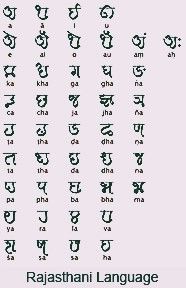
Languages often derive their names from the regions or communities where they are spoken. Sometimes, they are named after dialects or the people who use them. The Term Rajasthani follows this Convention, being named after the state of Rajasthan. Yet, this designation is relatively modern. Historically, the language was known as Maru Bhasa, a term used as early as 1587 AD by Gopal Lahori in his Ras-Vilas. Other variations such as Maru Bhum Bhasa, Maru-Bani, and Maru Bhasa highlight its deep cultural and literary roots.
Historical Evolution
The development of Rajasthani can be traced through the broader evolution of Indo-Aryan languages:
1. Vedic Sanskrit (1500–500 B.C.) — The earliest stage, known as Chandas.
2. Prakrit and Apabhramsa (500 B.C.–1000 A.D.) — Transitional forms that shaped regional languages.
3. Desi-Bhasas (from 1000 A.D. onwards) — Local languages, including Rajasthani, emerged.
Among the six major Prakrit forms Pali, Ardha-Magadhi, Saurseni, Maharastri, Magadhi, and Paisaci Saurseni Prakrit is most closely linked to Rajasthani. Originating in Mathura, it spread westward into Gujarat and Saurashtra, influencing phonetic changes such as dw becoming b (e.g., Dwaraka → Baraka).
Maru-Gurjar Influence
By the 11th century, Rajasthani began to take shape under the influence of Gurjar Apabhramsa. At this time, Rajasthani and Gujarati were nearly identical, diverging only after 1450 AD. Early literature from 1050–1450 AD is thus a shared heritage of both languages. The term Maru-Gurjar aptly describes this transitional phase, marking the linguistic foundation of Rajasthani.
Maru Bhasa and Dingal
Maru Bhasa, also known as Dingal, was considered synonymous with poetic and popular speech until the 19th century. Dingal was not only a literary medium but also a spoken form. The earliest references to Dingal and Pingal appear in the works of saint-poet Surjandas Puniya (1583–1691).
Pingal
Traditionally, Pingal refers to prosody, but in Rajasthan it came to denote a linguistic style blending Braj Bhasa with Rajasthani. Its grammar leaned toward Braj, while its vocabulary incorporated Rajasthani words. For example, the Rajasthani word Kad (waist) transformed into Kar in Pingal, though Karusually means hand. This illustrates the creative linguistic adaptations within Pingal, which remained primarily a poetic medium.
Branches of Rajasthani
Over time, Rajasthani diversified into several branches:
- Marwari-Mewari — Spoken in Jodhpur, Bikaner, Jaisalmer, Udaipur, and adjoining regions.
- Jaipuri-Hadauti — Found in Jaipur, Tonk, Bundi, Kota, and Jhalawar.
- Mewati-Ahirwati — Influenced by Braj and Haryanvi, spoken in Alwar, Bharatpur, and parts of Haryana.
- Malwi — A blend of Marwari and Jaipuri-Hadauti, with Gujarati and Marathi influences, spoken in Madhya Pradesh.
- Bhilli — Used in Dungarpur, Banswara, and parts of Mewar, with Gujarati influence.
Other variations include Uttaradhi or Ganganagari, shaped by migration and cultural exchange in Sriganganagar and nearby areas. Despite Differences in Accent and Vocabulary, the grammatical structure across these branches remains largely uniform.
Literary Tradition
Among all branches, Marwari stands out for its oldest, richest, and most continuous literary tradition. From medieval poetry to modern literature, it has preserved the essence of Rajasthani culture and identity.
Rajasthani’s journey from Maru Bhasa to its modern form reflects centuries of linguistic evolution, cultural exchange, and regional diversity. It remains not just a language but a living testament to Rajasthan’s history, literature, and society.