
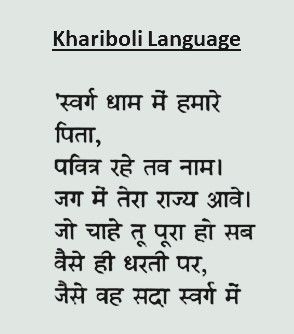
Khariboli, also known as Khadiboli or Khari, literally translates to “standing dialect.” It is a Western Hindi vernacular spoken mainly in rural regions of Delhi, Western Uttar Pradesh, and southern Uttarakhand. This dialect holds immense linguistic and cultural importance, as it is widely regarded as the precursor to the Hindi-Urdu prestige dialect. Both Standard Hindi and Urdu, the official languages of India, trace their literary roots back to Khariboli.
Origins and Historical Development
Khariboli is believed to have emerged between 900–1200 CE, alongside other major dialects such as Braj and Awadhi. Its distinct phonetic and grammatical features, particularly consonant germination (doubling of consonants), set it apart from its contemporaries. This unique sound system differentiates Khariboli from Awadhi, Braj, and even modern Standard Hindi-Urdu.
By the 19th century, Delhi’s role as an administrative hub elevated Khariboli’s status. It was considered a higher standard of Hindi dialect, especially when Fort William College in Calcutta encouraged professors to write in vernacular languages. This initiative produced notable literary works such as Naasiketopaakhyan, Premsagar, Rani Ketaki ki Kahani, and Sukhsagar. Other texts like Yogavashishtha and Mandovar ka Varnan further enriched the literary tradition. After India’s independence, Khariboli was formally recognized as an official language, cementing its role in shaping modern Hindi.
Distribution and Regional Presence
Khariboli is spoken across several regions in North India:
- Delhi: Predominantly in rural areas surrounding the capital.
- Uttarakhand: Districts such as Dehradun and Haridwar, located in the Yamuna-Ganges doab, partially use Khariboli.
- Uttar Pradesh: Widely spoken in Muzaffarnagar, Meerut, Bulandshahr, Saharanpur, Baghpat, and Ghaziabad. The Rohilkhand region—comprising Moradabad, Bijnor, Rampur, and Jyotiba Phule Nagar—also embraces the dialect.
- Haryana: Yamuna Nagar is a partial Khariboli-speaking area.
Interestingly, linguists now suggest that the term “Kauravi” can also be applied to the dialect spoken in Khari-speaking areas, particularly stretching from Agra to Saharanpur.
Linguistic Features
Khariboli’s distinctiveness lies in its phonology and grammar:
- Vowel length: Variations in vowel duration contribute to its unique sound.
- Consonant germination: Doubling of consonants creates a rhythm distinct from Standard Hindi-Urdu.
- Verb forms: Differing verb conjugations highlight its divergence from other dialects.
- Aspiration: Limited loss of aspiration distinguishes it from related dialects.
- Vocabulary: Certain words differ significantly from Standard Hindi-Urdu, reinforcing its independent identity.
These features make Khariboli a vibrant dialect, separate yet foundational to the Hindi-Urdu continuum.
Cultural and Literary Significance
Although once dismissed as rustic and unrefined, Khariboli gradually gained prestige through government support and literary adoption. While older dialects such as Braj, Awadhi, and Maithili have declined in everyday use, Khariboli has thrived, evolving into The Backbone of Modern Hindi and Urdu. Its transformation from a rural vernacular to a literary and official language underscores its resilience and adaptability.
Conclusion
Khariboli is more than just a dialect it is a linguistic bridge connecting India’s past with its present. From its medieval origins to its modern recognition, Khariboli has shaped the cultural and literary landscape of North India. Despite its rustic beginnings, it has emerged as the foundation of two of India’s most important languages, Hindi and Urdu. In doing so, Khariboli continues to stand tall, true to its name as the “standing dialect.”