
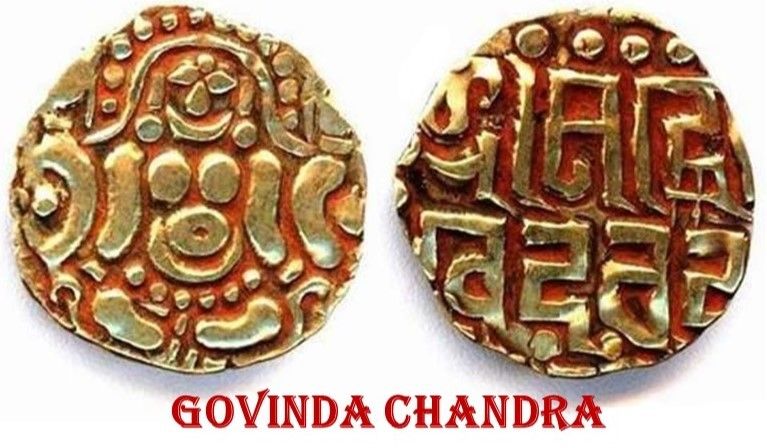
Govinda Chandra, who ascended the throne in 1114 A.D. after the reign of his father Madanpala, is remembered as the most powerful monarch of the Gahadavala dynasty. His rule marked the pinnacle of the dynasty’s political influence, military strength, and cultural achievements. Even during his father’s lifetime, Govinda Chandra had displayed remarkable administrative and military skills. As yuvraj, he defeated Masuda’s commander Haziba Tugatagina, proving his capability as a warrior and leader. Once crowned, he pursued an ambitious imperialistic policy that expanded his dominion across northern India.
Expansion and Conquests
One of the most debated aspects of his reign is the concept of Nava Rajyagana. Historians differ in their interpretations: some associate it with Gandhipura of Gopala, others believe it referred to the territory between Ghaghara and Dandaka conquered from Kirtipala, while a third group suggests it symbolized his authority over nine mandals of the mythical Jambu islands. Regardless of interpretation, it reflects his vast territorial ambitions.
Govinda Chandra also secured victories against the Kalachura dynasty, incorporating regions south of the Yamuna River into his empire. His campaigns against the Palas are evidenced by inscriptions from Lara and Manera, which suggest he temporarily controlled Muddagagiri. Similarly, his war with the Chandelas brought Chhatarpur under his authority, though later records indicate the Chandelas regained control.
Another significant conquest was Dasharna in eastern Malava, ruled by the Parmara king Yashovarman. Literary evidence from the drama Rambhamanjari confirms this victory. On the day of this triumph, Govinda Chandra’s grandson was born, and in commemoration of the conquest, he was named Jaya Chandra—a name that would later become prominent in Gahadavala history.
Diplomacy and Relations
Govinda Chandra was not only a warrior but also a skilled diplomat. He cultivated alliances with neighboring states, maintaining cordial relations with Jai Singh of Kanyakubja as recorded in Rajatarangini. His influence extended to Kashmir, where he had representation in scholarly councils. Inscriptions from Trichanapalli and Ratanpur further highlight his friendly ties with the rulers of Tanjore and the Kalachuri king Jajjaladeva I. These alliances strengthened his empire’s stability and prestige.
Extent of the Empire
At its height, Govinda Chandra’s empire stretched from Delhi to Monghyr and from the Himalayan Terai to the Yamuna River. The Tomaras, Gopalas, and Rashtrakutas acknowledged his supremacy as subordinate rulers. His reign of forty years marked the zenith of the Gahadavala dynasty, with numerous gold, silver, and copper coins discovered from his period, attesting to the prosperity and economic vitality of his rule.
Patronage of Literature
Govinda Chandra’s reign also witnessed intellectual and literary progress. His minister Lakshmidhar composed the celebrated legal treatise Kratyakalpataru. Other works such as Yavahara Kalpataru, Davakalpataru, Rajadharma Kalpataru, and Vivad Kalpataru were also produced during this era, though they are no longer extant. These texts reflect the scholarly environment fostered under his patronage.
Defense Against Muslim Invasions
An inscription from Sarnath portrays Govinda Chandra as an incarnation of Hari Bhagavan, born to protect Varanasi from Muslim invasions. This suggests he resisted attacks from the Ghaznavid rulers or their governors, defending one of the most sacred cities of India. His role as protector of Varanasi elevated his stature among his subjects.
Family and Succession
Govinda Chandra was married to four queens Nainakali Devi, Goshala Devi, Kumar Devi, and Basanta Devi. He had three sons: Asphota Chandra, Rajya Paldeva, and Vijaya Chandra. After his death, Vijaya Chandra succeeded him, while the names of the other two sons fade from historical records.
Legacy
Govinda Chandra’s reign combined military prowess, diplomatic acumen, cultural patronage, and religious devotion. His ability to expand and consolidate the Gahadavala Empire while fostering literature and defending sacred cities ensured his place as one of the most formidable rulers of Medieval Northern India. His forty-year rule remains a defining chapter in the history of the dynasty, symbolizing its zenith in power and prestige.