
Introduction
The development of soil for agriculture is a critical aspect of sustaining farming in Ladakh, a region marked by its high-altitude terrain, thin atmosphere, and extreme climatic conditions. Soil quality determines the productivity and sustainability of crops, and in Ladakh’s fragile ecosystem, maintaining soil health is both a challenge and a necessity. Chief indicators of soil quality include pH level, concentration of soluble salts, organic matter content, soil aggregation, and the availability of essential nutrients. Farmers must adopt practices that enhance these indicators to ensure long-term agricultural viability.
Soil Quality and Management
To maintain and improve soil health, Ladakhi Farmers incorporate organic manurebefore preparing land for cultivation. Organic matter enriches soil fertility, improves water-holding capacity, and strengthens soil structure, making it more resilient to erosion.
Soil degradation in Ladakh commonly occurs through wind and water erosion, as well as chemical deterioration such as salinization. To combat these issues, farmers are encouraged to plant erosion-resistant and nitrogen-fixing legumes like French beans, peas, and alfalfa. These crops stabilize the soil while naturally replenishing nitrogen, improving fertility without reliance on synthetic fertilizers.
In areas affected by severe salinity, excess salts can be leached out through controlled flooding, while the application of gypsum serves as an effective soil amendment to restore balance and promote healthy crop growth. These measures are vital in ensuring that Ladakh’s limited arable land remains productive.
Evolution of Agriculture in Ladakh
Traditionally, Ladakh’s agriculture was dominated by barley and wheat, which formed the staple diet of the population. Over time, households began increasing vegetable production, both for domestic consumption and as cash crops to meet the growing demand from the army and tourism industry.
The introduction of the public distribution system (PDS) in the region, however, led to increased dependency on imported food grains and a decline in the cultivation of traditional crops like barley and wheat. This shift reflects both the challenges of Ladakh’s environment and the changing socio-economic dynamics of its population.
Challenges of Traditional Farming
Ladakh’s harsh environment poses significant challenges to traditional farming. The region’s thin atmosphere, intense ultraviolet radiation, and scarce water resources limit the feasibility of open-field cultivation to only a few months each year. Moreover, nearly half of Ladakhi households own less than 0.5 hectares of land, restricting large-scale agricultural activity.
Protected Cultivation
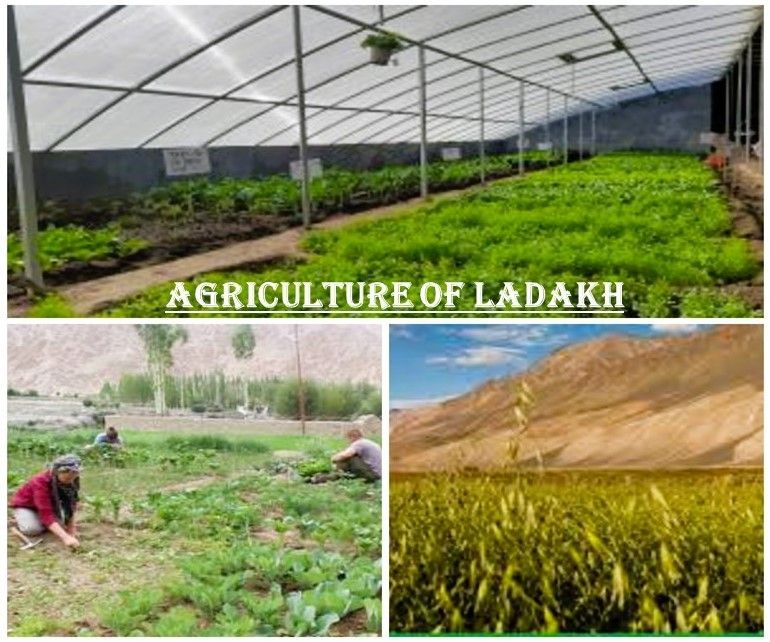
To overcome these constraints, Ladakh has embraced protected cultivation methods such as passive solar greenhouses, trench greenhouses, and low tunnels. These structures create controlled micro-environments that capture solar radiation and retain heat, enabling year-round or extended-season crop production.
The Defence Institute of High-Altitude Research (DIHAR) pioneered greenhouse agriculture in Ladakh in 1964. Early models were simple, built with mud-brick walls and polythene sheets. Over time, these designs were upgraded with triple-layered polycarbonate sheets for durability and transparency, heat-absorbing stone walls, and recessed foundations to enhance insulation. These innovations raised internal temperatures by 7–8°C above outside air, making winter cultivation possible.
Modern Greenhouse Farming
Today, Ladakhi farmers use modern greenhouses to grow a wide variety of crops. In winter, vegetables such as spinach, Swiss chard, cabbage, lettuce, Siberian kale, coriander, and fenugreekare cultivated. In summer, the same structures support crops like tomatoes, brinjals, and cucurbits. Greenhouses also function as off-season nurseries for fruit and vegetable crops, allowing seedlings of apple, apricot, pear, and vegetables to be started earlier than in open-field conditions.
Conclusion
The Development of Soil for Agriculture in Ladakh highlights the region’s resilience and innovation in the face of environmental challenges. By combining traditional practices like organic manure application and legume cultivation with modern techniques such as greenhouse farming and soil amendments, Ladakh has created a sustainable agricultural system. These efforts not only improve soil health but also strengthen food and nutritional security, ensuring that farming continues to thrive in this high-altitude desert.