
Introduction
Malayalam, a South Dravidian language spoken mainly in Kerala, has a rich history shaped by cultural exchanges and linguistic influences. Over centuries, the language absorbed elements from Indo-Aryan tongues due to the influx of Namboodiris into Kerala Cultural Life and trade relationships with foreign powers, especially the Portuguese. These interactions accelerated the inclusion of Sanskrit and other Indo-Aryan features into Malayalam, making it distinct among Dravidian languages.
Early Scripts and Evolution
In its early centuries, Malayalam was Written in Vattezhuthu, a script widely used across regions ruled by the Chera dynasty in Kerala and the Pandyas in Tamil Nadu. Vattezhuthu, with its rounded characters, was well-suited for palm-leaf manuscripts. While it disappeared from most of South India by the fifteenth century, Kerala continued to use it for nearly three more centuries.
From Vattezhuthu emerged the Kolezhuthu script, which retained the fundamental structure of its predecessor but adapted to regional needs. Kolezhuthu was more commonly used in the Kochi and Malabar areas, while Travancore favored other forms. Another derivative was Malayanma, prevalent in the southern regions near Thiruvananthapuram. Like Kolezhuthu, Malayanma did not differ fundamentally from Vattezhuthu, but each script reflected local variations in usage.
Classification of Malayalam
Malayalam belongs to the Dravidian language family, specifically the South Dravidian subgroup. Within this classification, it shares close ties with Tamil, from which it diverged between the 9th and 13th centuries. Despite this shared ancestry, Malayalam developed unique features:
- Absence of personal verb endings, unlike other Dravidian languages.
- One-to-one correspondence with Indo-Aryan languages, allowing smooth integration of borrowed vocabulary.
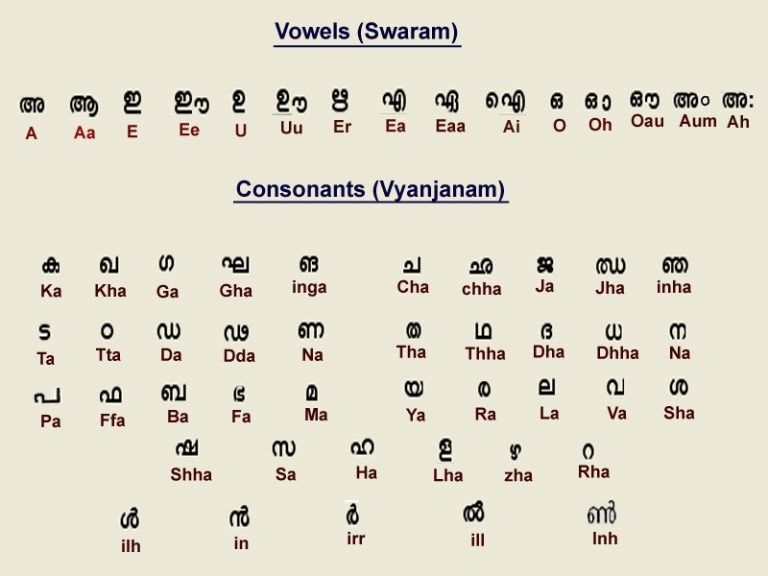
- A script system capable of representing both Sanskrit symbols and Dravidian-specific letters, making it versatile for literary and scholarly purposes.
Related Languages and Influences
Malayalam’s evolution cannot be understood without considering its relationship with related languages:
- Tamil: The closest relative, with which Malayalam shares its roots. Early Malayalam literature shows strong Tamil influence, though the two languages diverged significantly over time.
- Sanskrit: Through Namboodiri Brahmins and cultural exchanges, Sanskrit contributed heavily to Malayalam vocabulary, grammar, and literary style.
- Portuguese and other foreign languages: Trade brought new words and expressions into Malayalam, enriching its lexicon.
- Tulu and Kannada: Geographical proximity and cultural interactions led to shared features, especially in phonetics and vocabulary.
Dialects and Variations
Malayalam is marked by diversity in its spoken forms. There are five main regional dialects, shaped by geography, and several communal dialects, influenced by religious and social groups. This variety reflects the adaptability of Malayalam and its ability to absorb influences while maintaining a unified identity.
Cultural Significance of Scripts
The scripts derived from Vattezhuthu Kolezhuthu and Malayanma played a crucial role in preserving Malayalam’s early literature and administrative records. They highlight the language’s resilience and adaptability across centuries. Even as modern Malayalam adopted a script enriched by Sanskrit symbols, these earlier forms remain important markers of Kerala’s linguistic heritage.
Conclusion
Malayalam Classification as A South Dravidian Language and its relationship with Tamil, Sanskrit, and other regional tongues illustrate its dynamic evolution. From the ancient Vattezhuthu script to Kolezhuthu and Malayanma, Malayalam’s writing systems reflect its adaptability and cultural richness. The language’s ability to integrate Indo-Aryan features while retaining its Dravidian core makes it unique among Indian languages. Today, Malayalam stands as both a linguistic system and a cultural emblem, deeply rooted in Kerala’s history and identity.