
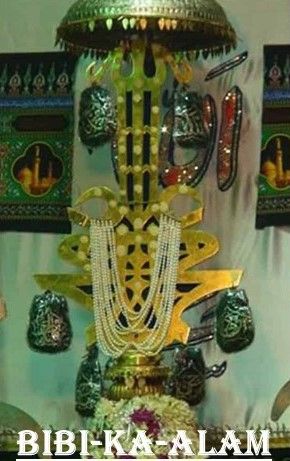
The Bibi-Ka-Alam, also known as Alam-e-Mubarak, is one of the most revered Shia religious processions in Hyderabad, India, observed annually during the sacred month of Muharram. This centuries-old tradition embodies devotion, grief, and cultural heritage, connecting generations of believers to the martyrdom of Imam Hussain, grandson of Prophet Muhammad.
Origins and Significance
On the 10th day of Muharram, the Alam is ceremoniously established at the Shi’ite Ashurkhana Dar-Us-Shifa in Honor of Imam Hussain, who sacrificed his life in the Battle of Karbala (60 Hijri). The procession begins at Alawa-e-Bibi in Dabirpura and concludes at Chaderghat, with mourners reciting Nauhey—poetic laments narrating the tragedy of Karbala. The locality Mohalla Bibi Ka Alawaitself is named after Hazrat Fatima-e-Zehra, daughter of Prophet Muhammad, symbolizing the deep spiritual roots of the event.
Historical Background
The practice of Azadari(mourning for Imam Hussain) flourished under the Qutb Shahi dynasty and continued during the reign of the Nizams of Hyderabad. The seventh Nizam, guided by Nawab Zain Yar Jung, revitalized the Ashurkhana, ensuring its preservation. Remarkably, the terrace and main entrance remain unchanged since 1299 Hijri, with the year of construction inscribed on the building.
The Alam itself is safeguarded inside a strong room designed like a Zarih (sarcophagus), emphasizing its sanctity and historical importance.
The Sacred Relic
At the heart of the Alam lies a revered relic—a wooden plank believed to be the one on which Janab Syeda’s husband performed her last ablution before burial. Originally preserved in Karbala, it was brought to Golkondaduring The Reign of Abdullah Qutub Shah.
The relic is enshrined within a calligraphic Alam inscribed with the names “Allah,” “Ali,” and “Mohammad.” It is adorned with gold and precious jewels donated by Nasir-ud-Daulah. A royal decree ensured jagirs (land grants) for attendants responsible for the procession. Traditional symbols of royalty—such as the mahi maratib (royal insignia), umbrella, and naubat (drums)—were prepared for the event. Two green gem-studded pouches shaped like earrings flank the Alam, enhancing its grandeur.
The Procession
The Bibi-Ka-Alam processionis considered the climax of Muharram mourning in Hyderabad. On the 10th day, the Alam is carried on an elephant, resembling a royal cortege. Mourners chant “Ibn-az-Zehra Wa Waila”—meaning “Goodbye Son of Zehra”—as a powerful expression of grief and protest against the martyrdom of Imam Hussain.
The atmosphere is filled with sorrow, devotion, and unity, as thousands of participants join in remembrance of Karbala’s sacrifice. The procession is not only a religious observance but also a cultural spectacle, blending spiritual devotion with Hyderabad’s rich historical legacy.
Conclusion
The Bibi-Ka-Alam processionis more than a ritual it is a living tradition that embodies centuries of faith, mourning, and reverence. It preserves the memory of Imam Hussain’s martyrdom and honors Hazrat Fatima’s sanctity, while reflecting Hyderabad’s unique blend of spirituality and royal heritage. Through its relics, chants, and symbolism, the procession continues to inspire devotion and unity, making it one of the most profound religious events in India.