
Introduction
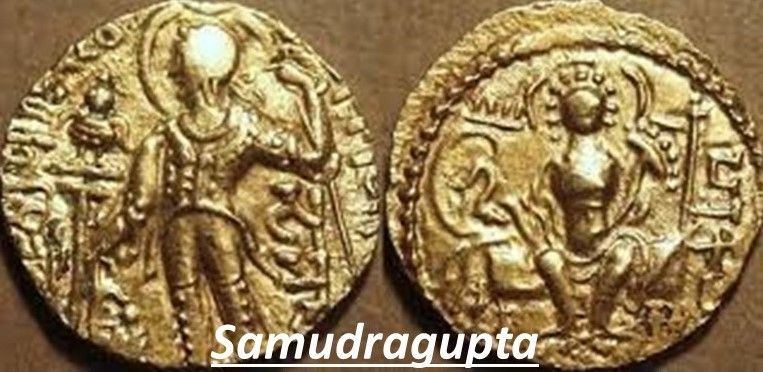
Samudragupta, who reigned between 350 and 375 CE, was the second emperor of the Gupta dynasty and is remembered as one of the greatest rulers in Indian history. His reign marked the beginning of the Golden Age of India, a period of political unity, cultural revival, and intellectual progress. Known both as a benevolent conqueror and a patron of arts and letters, Samudragupta transformed the Guptas from local powers in the Gangetic valley into a vast imperial force that dominated Northern and Southern India.
Military Achievements
Samudragupta’s military campaigns were dazzling in scale and execution. He exterminated nine kings of northern India, demonstrating his extraordinary military skill. His southern campaigns further proved his leadership and diplomatic acumen. Unlike a ruthless imperialist, Samudragupta’s expansionism was guided by the aim of political unification, peace, and order. His victories earned him the epithet “Indian Napoleon”, as described by historian Dr. Smith.
Political and Administrative Achievements
Samudragupta’s imperialism was not merely about conquest. He established a strong and well-knit empire that ensured stability and prosperity. His administration promoted equality and justice, removing discrepancies and offering opportunities to all. He was firm against wrongdoers but generous toward the virtuous. By consolidating territories and fortifying India’s frontiers, he safeguarded the empire against foreign invasions.
Patronage of Arts and Culture
Samudragupta was a man of versatile genius. Harisena, his court poet, praised him as a patron of poets, scholars, and musicians. He himself was an accomplished poet and musician, earning the epithet “King of Poets.” His coins depict him playing the veena, testifying to his passion for music. He promoted education, literature, and artistic expression, creating a flourishing cultural environment. Buddhist records also highlight his support for learning, showing his tolerance and encouragement of diverse traditions.
Religious Achievements
Samudragupta revived Brahmanical Hinduism, which had declined in prominence, by performing the Ashwamedha Yajna (horse sacrifice). This ritual reinforced his sovereignty and marked the beginning of neo-Brahmanical doctrine, which upheld the king as a divine incarnation on earth. His coins and inscriptions reflect his devotion to Vishnu, with references to him as “Parama Bhagavata.” Though some records are debated, his reign undeniably strengthened religious traditions while maintaining tolerance toward other faiths.
Intellectual and Material Progress
Samudragupta’s reign ushered in unprecedented intellectual and material progress. His policies encouraged trade, tribute, and cultural exchange, laying the foundation for the Gupta Empire’s prosperity. He believed that material welfare was essential for spiritual upliftment, a philosophy that distinguished him from earlier rulers like Ashoka. While Ashoka emphasized spiritual reform, Samudragupta focused on ensuring the material stability of his subjects, thereby enabling holistic progress.
Legacy
Samudragupta’s reign was the turning point that brought the Gupta dynasty into the limelight of ancient Indian history. His achievements in conquest, administration, culture, and religion initiated the Gupta Renaissance, a period often compared to Europe’s Renaissance for its intellectual and artistic vibrancy. Scholars like Dr. H.C. Roychowdhury even compared him to Ashoka, noting that Samudragupta’s versatility in art, culture, and governance surpassed Ashoka’s spiritual focus.
Conclusion
Samudragupta was not only a mighty conqueror but also a benevolent administrator, a patron of culture, and a visionary ruler. His reign laid the foundation for The Golden Age of India, where political unity, cultural revival, and intellectual progress flourished. By combining military prowess with cultural patronage and religious tolerance, Samudragupta ensured that his legacy would endure as one of the most remarkable chapters in Indian history.